Visual Arts Center

What is Home

July 17–November 30, 2026 | Jerstad Gallery

Featuring Artwork By

Willie Baronet and Leah den Bok

In this Exhibition

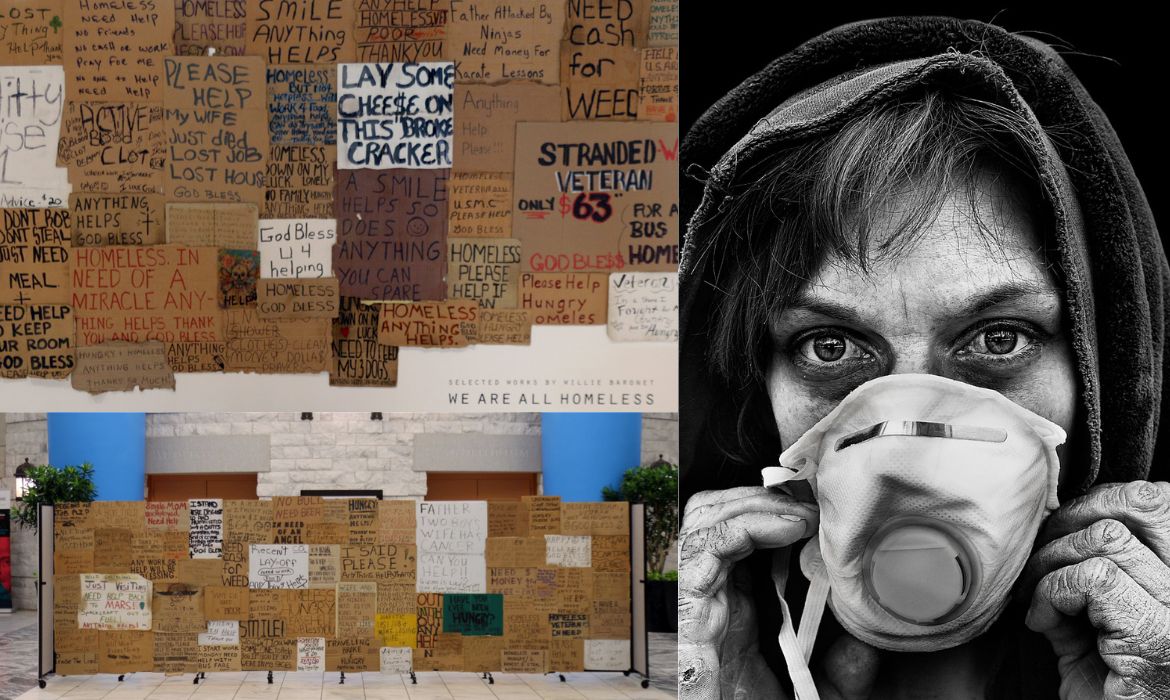
Willie Baronet has been buying and collecting homeless signs for over 32 years as part of a long term art project titled WE ARE ALL HOMELESS. In 2014 he began a 31-day cross country trip to buy signs in 24 cities, which is the subject of the documentary Signs of Humanity (currently available on Amazon Prime).

Leah den Bok is an internationally acclaimed photographer. Since 2015, she has been recognized worldwide for Humanizing the Homeless, an ongoing series of portraits and stories of people experiencing homelessness in cities such as Toronto, New York, Los Angeles, Dallas, Brisbane, and Kolkata. Her mission is to humanize these individuals and raise global awareness about homelessness.

Meet the Artists

Willie Baronet has been buying and collecting homeless signs for over 32 years as part of a long term art project titled WE ARE ALL HOMELESS. In 2014 he began a 31-day cross country trip to buy signs in 24 cities, which is the subject of the documentary Signs of Humanity (currently available on Amazon Prime).

The project has been featured in media all over the world, including Yahoo! News, NPR – All Things Considered, HuffPost, Al Jazeera America and Fast Company’s blog, posted by Katie Couric. An UpWorthy video about the project has been viewed over 6.5 million times, and there are other viral videos in English, French (Brut) and Russian (TOK media).

Research articles about this project have been published in The American Journal of Public Health, and The International Journal of Social Psychiatry. Both projects were done in collaboration with Dr. Rosemary Frasso, Phd, Program Director, Jefferson College of Population Health, Philadelphia.

Willie is currently the Stan Richards Professor in Creative Advertising at SMU’s Temerlin Advertising Institute, where he teaches classes related to creativity, design, and portfolio development.

Artist Statement

Since 1993 I’ve been buying and collecting homeless signs from people on the streets, in subways, under bridges, in cities near and far. It began due to the awkwardness I felt when I’d pull up to an intersection and encounter a person holding a sign, asking for help. Like many people I wrestled with whether or not I was doing good by giving them money, wondered how they would spend the money and how they got there. Mostly I struggled with my moral obligations, and how my own choices contributed in conscious or unconscious ways to the poverty I was witnessing. I struggled with the unfairness of the lives people are born into, the physical, mental and psychological differences. In my struggle I often avoided eye contact with those on the street, unwilling to really see them, and in doing so avoided seeing parts of myself.

That began to change once I began asking them if they would sell their signs. Immediately the dynamic changed between us, as we both had something the other wanted. Eventually I became more comfortable with the negotiations, and ultimately very comfortable in the conversations. I began to see them and hear them, and realized how vastly different they (and their stories) were from each other. My relationship to the people experiencing homelessness has been powerfully and permanently altered.

I still wrestle with personal questions regarding generosity, goodness, compassion and guilt. And what it means to be homeless: practically, spiritually, emotionally? Is home a physical place, a building, a structure, a house? Or is it a state of being, a sense of safety, of being provided for, of identity? I now see these signs as signposts of my own journey, inward and outward, of reconciling my early home life with my judgments about those experiencing homelessness.

Leah den Bok is an internationally acclaimed photographer. Since 2015, she has been recognized worldwide for Humanizing the Homeless, an ongoing series of portraits and stories of people experiencing homelessness in cities such as Toronto, New York, Los Angeles, Dallas, Brisbane, and Kolkata. Her mission is to humanize these individuals and raise global awareness about homelessness.

Leah’s work has been compiled into the acclaimed book series Nowhere to Call Home: Photographs and Stories of People Experiencing Homelessness, with 100% of her profits donated to local homeless shelters. Her photographs and stories have resonated worldwide, earning her features in major media outlets such as the BBC, CBS, and CBC. Leah has also exhibited and spoken at prominent events like ARTWALK New York, the Women of the World Festival in Brisbane, and She Talks in Ontario.

Leah has received numerous honours, including the Meritorious Service Medal from the Governor General of Canada. She was a finalist in the Nonfiction & Social Change category at the International Book Awards and received a Kirkus Star for Nowhere to Call Home in 2022. Leah has also earned an Honourable Mention in the International Photography Awards and the Ascend Pan Asian Leaders Rising Star Award in 2020. In addition, she received the Josko Rosenwirth Scholarship from Sheridan

Artist Statement

A couple of years ago, while driving through the countryside one night on my way to a speaking engagement, I hit a deer. As I stood in the middle of the road, looking at the poor creature, tears filled my eyes. The young doe, terrified and in pain, tried several times to get up and run away, but with her legs broken, she couldn’t. Eventually, she began to crawl away until she disappeared into the dark forest. When a police officer arrived, I told him where the deer had gone, hoping he would end her suffering. He told me he couldn’t do anything because she was on private property. ”The coyotes will get her,” he said, as if to reassure me.

As an animal lover, this experience was deeply traumatic. But what made it worse was watching, through my tears, as other drivers slowly maneuvered around the accident scene without even stopping to ask if I was alright. The lack of compassion I encountered that night is the same indifference people experiencing homelessness face every day.

Mother Teresa once said, ”The biggest disease today is not leprosy or tuberculosis, but rather the feeling of being unwanted, uncared for, and deserted by everybody.” This ”disease” is the same indifference and lack of love that people experiencing homelessness encounter on the streets.

In 2015, at the age of 15, I set out on a mission to humanize people experiencing homelessness and shine a spotlight on their plight. This mission has taken me to major cities around the world, where I’ve documented their struggles through photographs and stories. My goal is to convey one simple truth: people experiencing homelessness are just like you and me. They possess dignity and worth, regardless of their circumstances.

I challenge you to look into the eyes of the individuals in my photographs. Their eyes tell stories. stories of loneliness, fear, and rejection, but also of hope, longing, and gratitude. They express emotions common to all human beings. I also encourage you to read their stories. When my father and I began interviewing people experiencing homelessness, we were often struck by their willingness to open up to us, total strangers. Despite facing scorn and indifference from the public, they bared their souls, sharing their struggles with mental illness, addiction, grief, and trauma.

Will you look away, or will you have the courage to look them in the eye and listen to their stories? The choice is yours.

Plan Your Visit to the Washington Pavilion

Located in the heart of downtown Sioux Falls, the Washington Pavilion is home to South Dakota’s largest art museum and a must-visit destination for art lovers, families and visitors alike. Explore multiple galleries, rotating exhibitions and hands-on creative spaces all in one place.

Sponsored by

South Dakota Arts Council support is provided with funds from the State of South Dakota, through the Department of Tourism, and the National Endowment for the Arts.

Looking for events at your Washington Pavilion?

The region’s home for the arts, entertainment and science offers endless possibilities for fun and learning. View our calendar of events for our full schedule.